What Is the Origin and Meaning of the Christmas Tree?
Popular Christianity Q&A


Audio By Carbonatix
By Glory Dy, Crosswalk.com

The Christmas tree tradition developed in German-speaking Europe before spreading to Britain, America, and beyond. Although people used evergreen plants in winter celebrations long before Christianity, the decorated Christmas tree has its own history. Today, many Christians use its greenery, lights, and ornaments as reminders of eternal life, the light of Christ, and the joy of Jesus’ birth.
Whether your family decorates a towering fir or a small artificial tree, understanding this tradition can bring fresh meaning to a familiar Christmas activity. Here’s how Christmas trees became part of the holiday, and how their decorations can point our hearts toward Christ.
Where Did the Christmas Tree Tradition Begin?
The decorated Christmas tree is most closely associated with German-speaking Europe. Its development was gradual, and historians do not agree on a single first Christmas tree. Several European communities claim an early role in the tradition.
It helps to distinguish two related practices: using evergreen branches during winter and bringing a decorated tree indoors to celebrate Christmas. Evergreen decorations are much older than the Christmas tree custom familiar to us today.
Ancient Evergreen Traditions
Long before Christmas trees became common, people brought evergreen plants into their homes during winter. Their lasting greenery offered a reminder of life during the coldest, darkest part of the year. Evergreen plants also appeared in pre-Christian winter solstice celebrations.
These customs provide background for the use of winter greenery. However, they should not be treated as proof that every feature of the modern Christmas tree came directly from an ancient religious practice.
Christmas Trees in Germany
Decorated trees became associated with Christmas celebrations in German-speaking regions. Early examples included trees adorned with edible decorations such as apples, nuts, and dates. Over time, the custom spread more widely and became an established part of Christmas celebrations.
As families adopted the tradition, the evergreen tree became a place to gather, display decorations, and celebrate the season together.
Did Martin Luther Start the Christmas Tree Tradition?
A familiar story credits Martin Luther with adding candles to a Christmas tree after seeing stars shining through evergreen branches. According to the story, he wanted to recreate that beauty for his family.
The account is best presented as a legend rather than established history. Historian Bernd Brunner identifies the Luther story as probably legendary and notes that candle-decorated trees became more widespread later.
The story remains memorable because it connects a glowing tree with the wonder of Christmas. Still, the tradition developed over time rather than beginning with one clearly documented invention.
How Did Queen Victoria Help Popularize Christmas Trees?
Queen Victoria and Prince Albert helped make Christmas trees fashionable in Britain during the nineteenth century. Albert came from Germany, where the custom was already familiar.
In 1848, the Illustrated London News published an engraving of the royal family gathered around a decorated Christmas tree. The image helped bring the tradition to a wider audience.
An adapted version appeared in the American magazine Godey’s Lady’s Book in 1850, helping popularize Christmas trees in American homes as well.
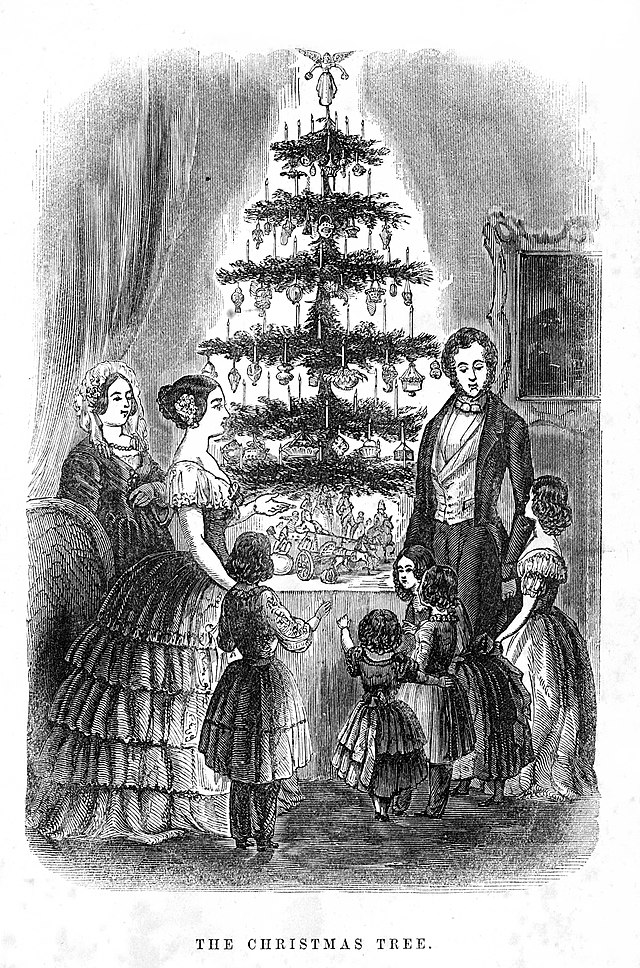
*Source: The Christmas Tree - Godey's Lady's Book, December 1850, Public Domain
This 1850 illustration helped introduce American readers to the custom of gathering around a decorated Christmas tree.
Who Brought Christmas Trees to America?
German immigrants helped introduce and popularize Christmas trees in the United States. The custom was one of several German traditions that became familiar parts of American Christmas celebrations during the nineteenth century.
The tradition did not become widespread everywhere at once. As immigrant communities shared their customs and popular publications featured decorated trees, more American families began adopting the practice.
By the mid-nineteenth century, Christmas trees were appearing in American community celebrations as well as homes. In Charleston, for example, a German Lutheran congregation advertised a decorated and illuminated Christmas tree at a fundraising festival in 1852.
When Did the Rockefeller Center Christmas Tree Tradition Start?
The Rockefeller Center Christmas tree tradition began in 1931, when construction workers pooled their money to buy a 20-foot balsam fir. They decorated it with homemade garlands at the construction site during the Great Depression.
1933, Rockefeller Center established the tree as an annual tradition. What began as a gathering place for workers grew into one of New York City’s best-known Christmas celebrations.
Its beginnings offer a fitting reminder that a Christmas tree does not need elaborate decorations to become meaningful. A simple tree can bring people together and mark a moment of gratitude and hope.
What Does the Christmas Tree Symbolize for Christians?
Christians can use Christmas trees as reminders of eternal life through Jesus, His light in the world, and the good news of His birth. These meanings are devotional connections families bring to the tradition, rather than rules the Bible gives for decorating.
Evergreen Branches: Eternal Life Through Christ
Because evergreen trees retain their foliage through winter, Christians can use them as a reminder of the eternal life promised through faith in Jesus Christ.
As you decorate, consider reading John 3:16 together. Let the tree’s greenery prompt a conversation about God’s love and the hope we have in His Son.
Christmas Lights: Jesus, the Light of the World
The lights on a Christmas tree can remind believers of Jesus’ words in John 8:12, where He identifies Himself as the Light of the World.
They also offer an opportunity to discuss Matthew 5:14-16. As followers of Jesus, we are called to let our light shine through good works that bring glory to our heavenly Father.
A Star: The Star of Bethlehem
A star at the top of the tree can help families remember the star associated with the Magi’s journey to find Jesus in Matthew 2.
Rather than focusing only on the decoration, take a moment to talk about the Magi’s response: they sought Jesus and worshiped Him.
An Angel: The Announcement of Jesus’ Birth
An angel ornament or tree topper can point readers back to Luke 2:8-14, when angels announced the Savior’s birth to shepherds.
For children especially, familiar decorations can become simple invitations to learn the Christmas story.
How Do Christmas Tree Traditions Differ Around the World?
Christmas trees have become part of celebrations in many countries, but decorations and accompanying customs vary. A few examples show how families combine shared traditions with local heritage.
Christmas Trees in Sweden
Swedish families decorate trees according to their own traditions, using items such as flags, tinsel, colored baubles, and lights. Choosing the tree in the days before Christmas Eve remains part of the seasonal celebration.
Christmas Trees and Boats in Greece
Alongside Christmas trees, Greece has a tradition of decorating boats, reflecting the country’s connection to the sea. These displays offer a distinctive expression of the Christmas season.
Christmas Trees in Britain
Britain’s Christmas tree tradition became especially fashionable during Queen Victoria’s reign. The royal family’s celebrations helped shape the image of a decorated tree surrounded by family, a scene still familiar today.
How Can Families Keep Christ at the Center of Christmas Tree Traditions?
Decorating the tree can become an opportunity to share your faith through small, thoughtful moments. You might:
- Read Luke 2:1-20 before turning on the tree lights.
- Explain a decoration’s meaning, such as a star, angel, or nativity ornament.
- Share something you are thankful for as each person hangs an ornament.
- Pray for someone who is struggling during the Christmas season.
- Choose a way to give together, such as supporting a neighbor or providing a gift for a family in need.
These moments do not have to be elaborate. A short prayer or conversation can help children and adults connect a beloved tradition with the Savior whose birth we celebrate.
Celebrating Jesus Through a Familiar Christmas Tradition
A Christmas tree can hold treasured ornaments, family memories, and reminders of people we love. For Christians, it can also become an invitation to reflect on the hope found in Jesus.
As you hang the lights or place the final ornament, take a moment to remember Bethlehem. The heart of Christmas is the birth of our Savior: the One who brings light, life, and lasting hope.
For further reading:
Is the Origin of Christmas Truly Rooted in Pagan Traditions?
Is it Important to Know Jesus’ Family Tree at Christmas?
What Is the Origin of Beloved Christmas Traditions?
What Is the Meaning of Christmas?
Photo Credit: ©iStock/Getty Images Plus/Drazen Zigic
Glory Dy has been a content creator for more than 10 years. She lives in a quiet suburb with her family and four cats.


